The agentic loop: how AI agents plan, code, test, and ship
The real engine of an autonomous agent is the loop, not the code generation. We walk through plan, code, test, verify, ship, and monitor, stage by stage.
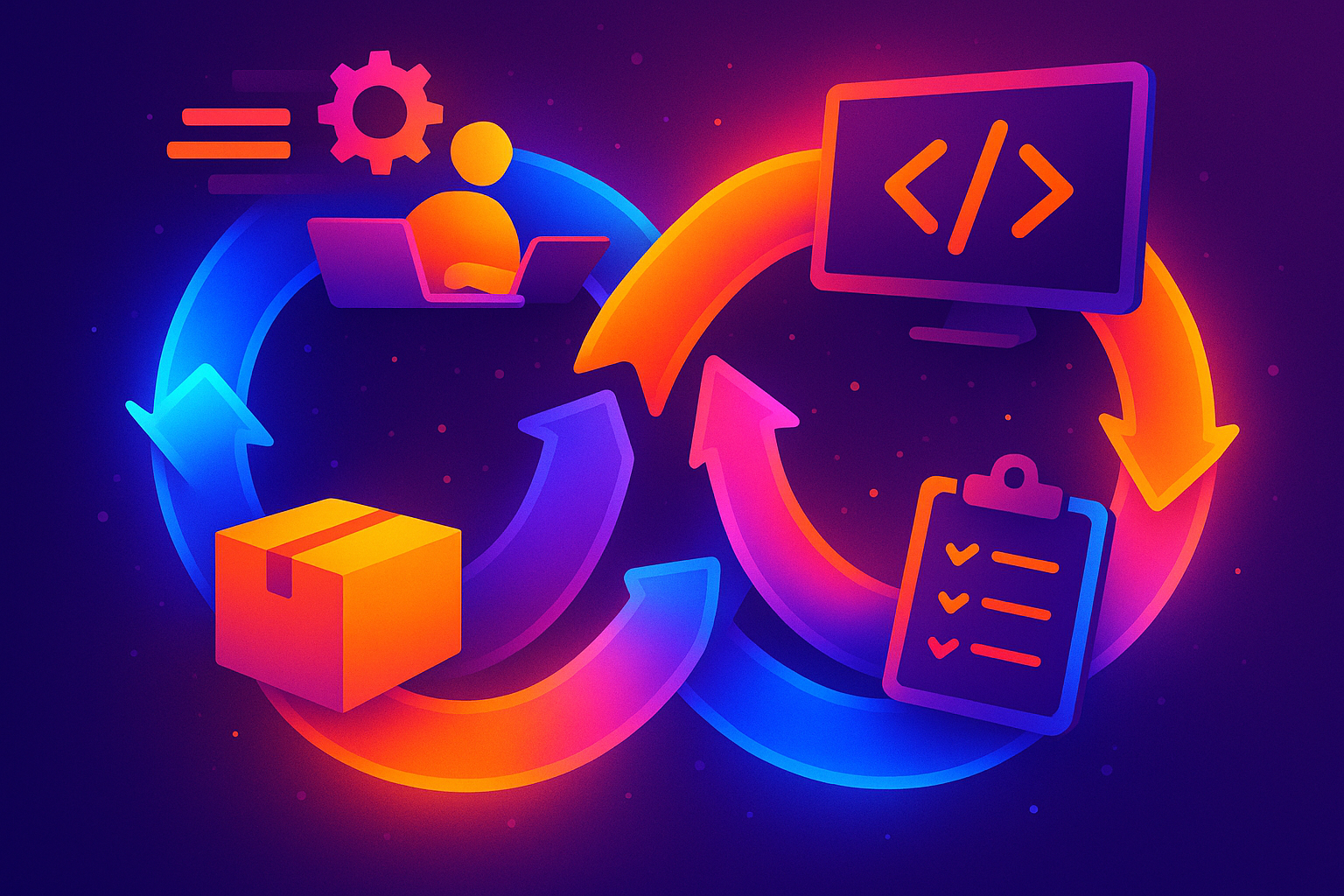
Most descriptions of AI coding agents focus on the moment the code appears. That is the least interesting part. The real engine of an autonomous agent is the loop: a repeating cycle of plan, code, test, verify, and ship that turns a fuzzy goal into a reviewed, deployed change. Understanding the loop is the difference between treating an agent as a novelty and using it as infrastructure.
This article walks through each stage of the agentic loop, what happens inside it, why each stage exists, and where the loop closes back on itself so the agent improves instead of repeating its mistakes.
Stage one: plan
A goal like "add rate limiting to the public API" is not executable. The first job of the agent is to turn it into a plan. That means locating the relevant code, understanding how requests currently flow, identifying where the limit should live, and deciding what "done" looks like, including the tests that would prove it.
Planning is where good agents and weak ones diverge. A weak agent jumps straight to code and discovers halfway through that it misunderstood the system. A strong agent front-loads the thinking, surfaces its plan, and only then starts editing. The plan is also the artifact a human can check fastest: it is far cheaper to correct a wrong plan than a wrong pull request.
Stage two: code
With a plan in hand, the agent writes. This is the stage people imagine when they think of AI coding, but in a healthy loop it is almost mechanical. Because the plan already named the files, the approach, and the definition of done, the coding stage is execution rather than improvisation.
Crucially, the agent edits across the whole change, not one suggestion at a time. It touches the handler, the middleware, the config, and the tests together, the way a human engineer would, keeping the change coherent rather than a pile of disconnected snippets.
Stage three: test
Code that has not been run is a guess. The testing stage is what makes an agent trustworthy. It runs the existing suite to catch regressions and writes new tests to cover the behavior it just added. Then it reads the results.
This is where the loop earns its name. A failing test is not a dead end; it is feedback. The agent reads the failure, forms a new hypothesis, adjusts the code, and runs again. It can repeat this inner loop many times in the span a human would spend reading a single stack trace. The willingness and ability to iterate against real test output is the single biggest reason agents outperform one-shot code generators.
Stage four: verify
Passing tests is necessary but not sufficient. Tests check what they were written to check; they do not guarantee the original goal was met. The verification stage steps back and asks whether the change actually satisfies the intent. Did "add rate limiting" produce a limit that triggers correctly, returns the right status code, and does not break authenticated traffic?
Verification guards against the classic failure mode of automated systems: optimizing the metric instead of the goal. An agent that only chases a green test suite can write a test that passes trivially. An agent that verifies against intent catches the gap between "the check is green" and "the feature works".
Stage five: ship
When the work is done and verified, the agent opens a pull request. This is deliberately where autonomy pauses. Reading, writing, and testing are reversible, so the agent did them on its own. Merging and deploying are not, so a human reviews and approves. The pull request is the handoff: a clean, scoped, tested change with a description of what it does and why.
A good agent makes review fast by keeping the change focused and explaining its reasoning, so the human is judging a coherent unit of work rather than reverse-engineering a sprawling diff.
Closing the loop: monitor and learn
The loop does not end at merge. After deploy, the agent watches production: error rates, latency, logs, the signals that tell you whether the change behaved in the real world the way it did in tests. If something regresses, that observation becomes the planning input for the next cycle. The agent is not shipping into a void; it is shipping into a feedback system it keeps reading.
This is what people mean when they say an agent "gets sharper with every pass". Each loop produces evidence, and that evidence shapes the next loop. Over time the agent accumulates a working understanding of the codebase and its failure modes, the same way a human engineer does, just faster.
Once you trust a single loop, the next question is running several at once. That is the idea behind multi-agent desktop tools like DevMesh, which orchestrates a swarm of agents through these loops in parallel while you steer them from one workspace.
Conclusion
The agentic loop, plan, code, test, verify, ship, monitor, is the actual product of an autonomous engineering agent. The code generation everyone fixates on is just one stage of six. The power comes from the cycle: planning before coding, iterating against real test output, verifying against intent rather than metrics, pausing for human approval at the irreversible step, and feeding production signals back into the next pass.
Aion is built as this loop end to end. If you want to see plan-code-test-ship running as a closed system rather than a one-shot trick, take a look at aionagent.app.
Last updated & verified · Aion team