Human-in-the-Loop: Approval Gates for AI Agents
Autonomous agents don't know when to stop. Approval gates put a human at the boundaries where mistakes get expensive, without slowing the reversible middle.
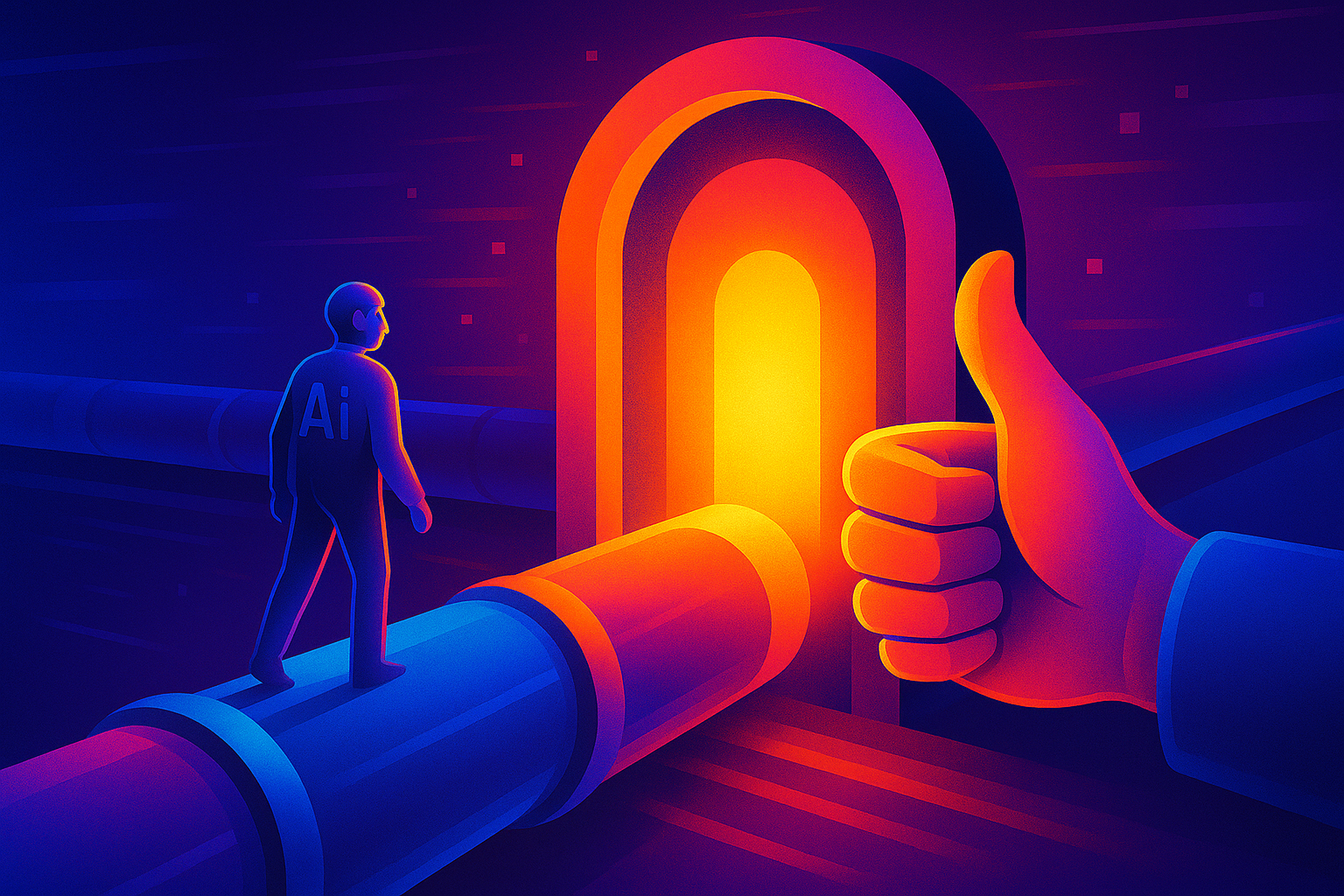
Autonomous coding agents are good at producing work and bad at knowing when to stop. Give one a task and it will happily refactor a module, migrate a schema, delete a file it decided was dead, and open a pull request, all without pausing to ask whether any of that was a good idea. Most of the time the output is fine. The problem is the rest of the time, and the fact that a confident agent gives you no signal about which kind of run you are looking at. An approval gate is the mechanism that turns that blind trust into a decision a human actually makes. This is a practical look at why gates matter, where to put them, and how to design them so they help instead of turning into theater.
What an approval gate actually is
An approval gate is a hard stop the agent cannot cross on its own. It pauses at a defined boundary, presents what it is about to do, and waits for a human to allow or reject it. The important word is before. A gate is not a notification that something happened, and it is not a review of finished work you can no longer easily undo. It is a checkpoint placed at the exact moment an action becomes expensive or irreversible, positioned so that a person is in the loop while the decision is still cheap to change.
That distinction sounds obvious and is constantly violated in practice. Teams wire up an agent, let it run end to end, and call the pull request review their "human in the loop." By then the agent has already made every consequential choice. The reviewer is not approving the decision, they are archaeologically reconstructing it from a large diff, which is exactly the situation gates exist to prevent.
Why reviewing at the end is not the same thing
When a human writes code, judgment happens continuously. You reason about a risky change as you type it, and the slowness of writing is itself a form of review. An agent removes that friction. It emits a hundred lines in seconds, and the code looks finished before anyone has thought about whether it is correct. The implicit review that used to be baked into the act of writing simply vanishes.
End-of-run review tries to add that judgment back at the worst possible moment: after the work is done, bundled into one large change, with the agent's confidence attached. The plausible-but-wrong change, the one that quietly weakened a test assertion or widened a permission, is the one most likely to slip through, because it looks exactly like the correct changes around it. A gate placed earlier, at the point of the risky decision rather than at the end of the run, keeps the change small enough and early enough that a human is judging one thing instead of sifting a finished pile.
Where gates belong, and where they do not
The goal is not to gate everything. It is to gate the boundaries where a mistake stops being cheap. In practice those boundaries are consistent across projects:
- Anything that leaves the sandbox. Pushing to a shared branch, opening or merging a pull request, deploying, or writing to a system other people depend on.
- Irreversible or destructive operations. Deleting files or data, dropping database objects, rewriting git history, force-pushing, mass find-and-replace across the tree.
- Actions with real-world side effects. Sending email, calling a third-party API that changes state, moving money, touching production infrastructure or secrets.
- Spend and scope. A task that is about to balloon in cost, or wander far outside the boundary it was given.
Everything inside those boundaries should stay ungated. An agent editing files in its own workspace, running tests, iterating on a failing check, and trying approaches should move at full speed with no human in the way. Gating the cheap, reversible middle of the work is how you destroy the entire value of using an agent. The skill is drawing the line at the point where an action becomes hard to take back, and letting the agent run free right up to it.
The failure mode nobody plans for: approval fatigue
The most common way gates fail is not too few of them, it is too many. When an agent stops to ask about every trivial step, the human on the other end learns to click approve without reading. The gate is still there on paper, but it has become a rubber stamp, and a rubber stamp is more dangerous than no gate at all because it manufactures a false record of oversight. The one time the agent proposes something genuinely wrong, it gets waved through with the same reflex as the two hundred harmless prompts before it.
Good gate design fights this directly. Each gate has to be rare enough that seeing one means something, and informative enough that a human can make a real judgment in a few seconds. That means showing the specific action and its blast radius, not a wall of context. If your reviewers are approving faster than they can read, the answer is fewer, sharper gates, not more of them.
Designing gates the agent and the human both respect
A gate is only as good as the information it carries. "The agent wants to run a command, allow?" is a weak gate, because it pushes the entire cost of understanding onto the human. A strong gate states what will happen, what it will affect, and what cannot be undone: which files, which table, which environment, whether the change is reversible. The human should be able to say yes or no on the strength of the prompt alone, without going to dig through logs to reconstruct what the agent even means.
Two principles keep gates healthy over time. First, bounded autonomy: give the agent a wide lane to operate in and a hard wall at the edge, rather than a hundred little speed bumps throughout. Second, make the default safe. If a gate times out or a human is unavailable, the action should not proceed on its own. An agent that falls back to acting when no one answers has no gate at all, only a delay.
Gates as trust, audit, and the reason teams adopt agents at all
It is tempting to see approval gates as a brake on an otherwise fast system. They are closer to the opposite. Gates are what make it rational to hand an agent real work in the first place. A team that knows every irreversible action requires an explicit human yes can safely give the agent far more autonomy everywhere else, because the downside is capped. Remove the gates and you are forced to either supervise everything or trust everything, and neither scales.
Gates also produce something valuable as a byproduct: a clean record of who approved what and when. When a change lands in production, the trail of decisions is explicit rather than buried in an agent's internal reasoning. That auditability is not bureaucratic overhead, it is what lets an organization actually stand behind software an agent helped build.
Conclusion
Human-in-the-loop is not a slogan you satisfy by reading a diff at the end. It is a design decision about where an agent must stop and ask, placed at the exact boundaries where mistakes get expensive: the edge of the sandbox, irreversible operations, real-world side effects, and runaway scope. Get the placement right and you get the best of both worlds, an agent that moves fast through the cheap middle of the work and a human who owns every consequential decision. Get it wrong in either direction, too many gates or too few, and you get rubber-stamping or unchecked damage. aionagent is built around this division of labor: autonomous where the work is reversible, and a hard stop with a real human decision wherever it is not. See how it handles approval gates at https://www.aionagent.app.
Last updated & verified · Aion team