AI Automation Across the Software Development Lifecycle
AI automation now spans the whole software lifecycle, from planning to incident response. A practical map of where it helps and where judgment stays.
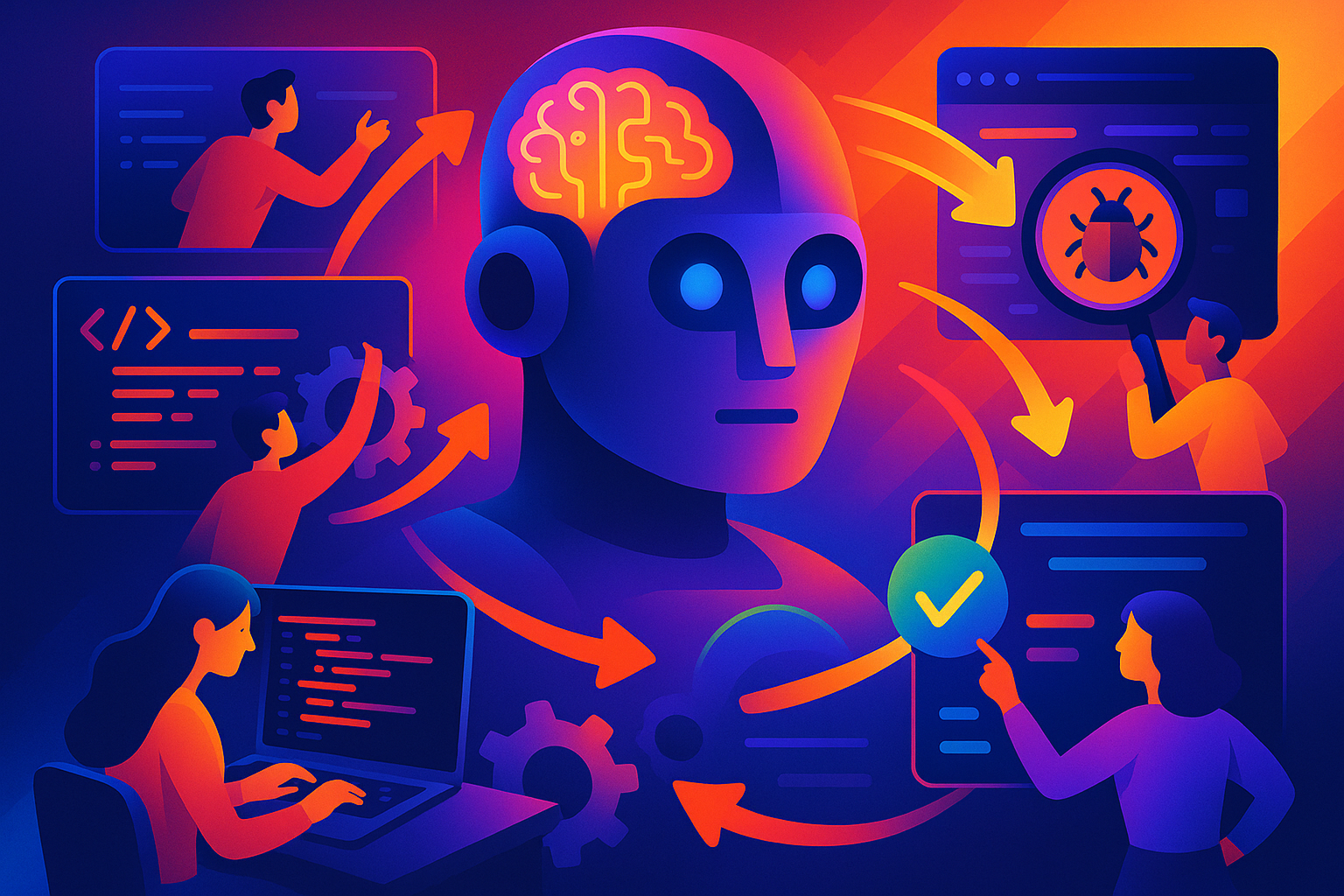
Most teams talk about AI in software development as if it begins and ends with code completion. An engineer types, a model suggests the next few lines, and that is the story. It is a narrow view of a much larger shift. Automation is now reaching into every phase of the software development lifecycle, from the first ambiguous feature request to the third 2 a.m. page about the same flaky service. The interesting question is no longer whether AI can write a function. It is which parts of the lifecycle still require a human in the loop, and which can be handed off with confidence.
This piece walks the lifecycle stage by stage, looking at where automation genuinely moves the needle, where it quietly creates risk, and what changes for the people responsible for shipping reliable software.
Mapping automation onto the lifecycle
The software development lifecycle is usually drawn as a loop: plan, design, build, test, release, operate, and back to plan. Each stage has its own inputs, its own definition of done, and its own failure modes. The mistake teams make is treating AI as a single tool bolted onto the build stage, when in practice the leverage is unevenly distributed across the whole loop.
Some stages are dominated by mechanical, repetitive work that follows clear rules. Those are the natural candidates for automation. Others are dominated by judgment, tradeoffs, and incomplete information. Those benefit from AI as an assistant, not an owner. Knowing the difference is the entire game. A team that automates the wrong stage ends up with confident, fast, wrong decisions. A team that automates the right stage frees its engineers to spend their attention where it actually matters.
Planning and design: the underrated frontier
Planning is where most teams assume AI has little to offer, and where it often has the most. Turning a vague request into a concrete, testable specification is slow, manual work. An agent that can read an existing codebase, summarize how a feature is currently implemented, and draft a technical design with explicit edge cases removes hours of archaeology from every ticket.
The value here is not the prose. It is the surfacing of hidden complexity early, when changing direction is cheap. An AI that reads the actual code and points out that a proposed change touches three services and an undocumented migration is doing real design work. The human still decides. But they decide with a map instead of a blank page.
- Requirement clarification: generating the questions a senior engineer would ask before estimating.
- Impact analysis: tracing which modules, tests, and contracts a change would affect.
- Design drafts: producing a first proposal that the team edits rather than authors from scratch.
Coding and review: past autocomplete
Code generation is the most visible form of AI automation, but autocomplete is the least interesting version of it. The meaningful shift is toward agents that take a described task and carry it end to end: read the relevant files, make coordinated edits across them, run the test suite, read the failures, and iterate until the change is green. That is a different category of work from suggesting the next line.
Review is the other half. AI reviewers that flag risky patterns, missing error handling, or inconsistencies with the rest of the codebase catch a class of issues before a human reviewer spends attention on them. This does not replace human review. It raises the floor, so the human review can focus on architecture and intent rather than style nits and obvious omissions.
Testing, integration, and release
Testing is where automation has the clearest return, because the work is both essential and tedious. Generating test cases from a specification, filling coverage gaps, and producing regression tests for a freshly fixed bug are all tasks that follow patterns an agent can learn. The harder and more valuable capability is an agent that writes a failing test that reproduces a reported bug, then writes the fix, then confirms the test passes.
In the release path, automation has lived in CI/CD pipelines for years, but those pipelines are static. They run the steps you wrote and nothing more. An AI layer that can read a failed build, diagnose whether the cause is the code, a flaky test, or an infrastructure hiccup, and either fix it or route it to the right person, turns a brittle pipeline into an adaptive one. The goal is not to remove the gates. It is to stop wasting human time on failures that have an obvious cause.
Operations and incident response
Once software is running, the lifecycle does not stop, it just gets noisier. Logs, metrics, traces, and alerts pour in faster than any on-call engineer can read. This is exactly the kind of high-volume, pattern-heavy environment where automation earns its place. An agent that correlates a spike in errors with a recent deploy, pulls the relevant code change, and drafts a hypothesis about the cause compresses the slowest part of incident response: figuring out where to look.
The discipline here is to keep the human in command of the irreversible actions. Diagnosing an incident and proposing a rollback is a safe thing to automate. Executing that rollback in production without a human decision is not, at least not until the team has earned deep trust in the system. Automation should shorten the distance to a good decision, not quietly make the decision on its own.
What changes for engineering leaders
When automation spreads across the lifecycle, the job of leading an engineering team changes shape. The bottleneck moves from writing code to reviewing, directing, and verifying work that an agent produced. That demands new habits: clear task definitions an agent can act on, guardrails around what an agent may touch without sign-off, and observability into what the automation actually did.
The teams that get this right treat AI agents the way they treat a capable but new team member. They give clear context, scope the work, review the output, and expand autonomy as trust is earned. The teams that get it wrong either refuse to delegate anything, and capture none of the benefit, or delegate everything blindly, and inherit a codebase no one understands. The middle path, deliberate delegation with verification, is where the real productivity lives.
Conclusion
AI automation across the software development lifecycle is not a single feature. It is a rebalancing of where human attention goes. The repetitive, pattern-heavy work spread across planning, coding, testing, and operations is increasingly handled by agents, while the judgment calls, the tradeoffs, and the irreversible decisions stay with the people accountable for them. The lifecycle does not get shorter. It gets denser, with more shipped per unit of human attention.
If you want to see what a genuinely autonomous engineering agent looks like across these stages, not a smarter autocomplete but an agent that plans, edits, tests, and verifies its own work, take a look at aionagent.app.
Last updated & verified · Aion team